How complex is a migration from Citrix or RDS to Horizon really?

Technically manageable – organizationally often made more complicated than necessary.

“It’s not the platform that’s the problem, but perfectionism, feature debates, and too much planning without execution. This is exactly where a pragmatic approach comes in – what I like to call the ‘Migration Superhighway.’”
Anastasios Ntaflos
Business Area Lead Mod | Microsoft MVP | Omnissa Tech Insider | evoila
A migration from Citrix or traditional RDS environments to Horizon often appears more complex at first glance than it actually is. In many projects, it quickly becomes clear that technology is not the limiting factor – the real challenge lies in how the migration is approached. Too much perfectionism, endless feature discussions, and an overloaded planning phase often cause projects to stall before the first user has even been migrated. Yet the real key to success is surprisingly simple: focus, pragmatism, and a clear view of the desired outcome.
When organizations consider switching platforms, the same questions almost always arise. How easy or difficult is the transition really? Should the migration be done step by step, or is a clean cut possible? How should legacy technical debt be handled? And above all: what does the change mean for end users and operations? The answers may vary depending on the organization, but the fundamental path toward Horizon follows a very similar pattern in most cases.
A structured path through the migration
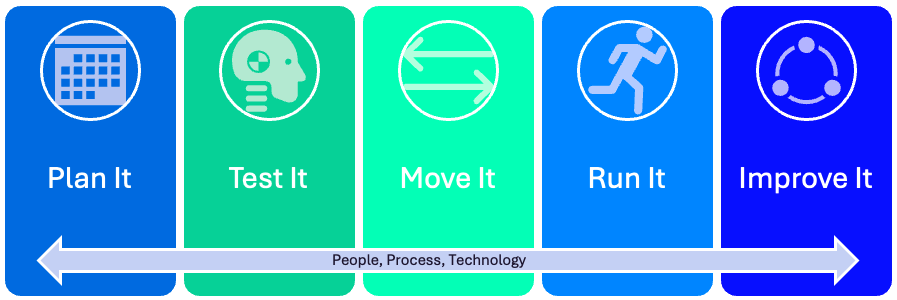
It is helpful not to view migration as a one-time large-scale project, but as a clearly structured process. A proven approach is the so-called “Migration Superhighway,” which divides the path into five phases. First, the focus is on planning. The point is less to perfect every technical detail in advance, and much more to understand the starting situation, define clear goals, and set responsibilities. Anyone who does not know why they are migrating and what outcome they want to achieve will inevitably get lost in details. It is just as important to think about communication early and not bring users on board only shortly before go-live.
This is followed by the test phase, in which assumptions are replaced by reality. Pilot users and manageable use cases provide valuable insights that no architecture diagram can replace. In this phase, runbooks and documentation are also created, which later help to scale the migration and reduce human error. Tests are not an end in themselves, but the foundation for ensuring that the actual rollout can take place in a controlled and predictable manner.
In the move phase, planning and testing finally turn into execution. Users are migrated, images adjusted, agents swapped, or new desktops provided. Surprises can never be fully avoided; what matters, however, is how you deal with them. Migration does not mean everything works smoothly, but that problems are identified, prioritized, and solved quickly. Speed does not come from perfection, but from the ability to act.
A frequently underestimated aspect is ongoing operations. The question of how the Horizon platform will be operated during and after the migration should not be asked only at the end. Operations and support processes, image lifecycle management, application delivery, and patch strategy must be established and further developed in parallel with the migration. Anyone who ignores this risks that the new platform works technically, but is not operationally viable.
Only when the migration has picked up speed or is largely complete does the improvement phase begin. Now is the right time to deliberately reduce technical debt, clean up legacy baggage, and further modernize the platform. Topics such as dynamic application delivery, profile management, or an upgrade to a new operating system unfold their value here without unnecessarily slowing down the migration process. The important thing is that improvements do not become the next blocker. Not everything that is possible has to be implemented immediately.
Above all of this is a clear mindset. The focus should always be on the end user experience, not on the technical elegance of the solution. Migration pace and approach are determined by business and organizational requirements, not by technical ideals. Compromises are unavoidable and not a sign of weakness as long as they are made consciously and documented. Technical debt cannot always be avoided immediately, but it can be managed if it is made visible and planned into later phases.
In the end, it becomes clear again and again: a migration to Horizon is not rocket science. Anyone who structures the path clearly, has the courage not to want to solve everything at the same time, and consistently puts the user at the center creates the basis for a stable, modern, and future-proof digital workspace platform. Migration is not an end point, but the starting point for continuous improvement.
The same questions before a migration
The Migration Superhighway: structure instead of complexity
It is helpful not to view migration as a one-time large-scale project, but as a clearly structured process. A proven approach is the so-called “Migration Superhighway,” which divides the journey into five phases. This structure helps to reduce complexity and keep the focus on what matters.

In the first phase, Plan it, the goal is to understand the starting situation and define clear objectives. Why are you migrating, what results are to be achieved, and who takes on which tasks? The point is explicitly not to perfect every technical detail in advance. Anyone who tries to clarify everything upfront risks coming to a standstill. It is just as important to think about communication early and not bring users on board only shortly before go-live.

This is followed by Test it. In this phase, assumptions are replaced by reality. Pilot users and manageable use cases provide valuable insights that no architecture diagram can replace. At the same time, runbooks and documentation are created, which later help to scale the migration and reduce human error. Tests are not an end in themselves, but the foundation for a controlled rollout.

In the third phase,Move it, the actual transition begins. Now the migration happens – step by step, controlled, and with clear waves. The decisive factor is that technology, processes, and communication work together. A stable migration rhythm ensures that both IT and business units know what happens next. Important: feedback from the first migrations flows directly into the next ones. This turns a theoretical plan into a learning process.

Phase four, Run it, is underestimated in many projects. After migration is before operations. Now it becomes clear whether the new setup is really suitable for day-to-day use. Monitoring, support processes, and clear responsibilities ensure that the platform runs stably and users build trust. At the same time, the foundations for optimization emerge here – based on real usage instead of assumptions.

Finally,Improve it follows. Migration is not an end point, but the start of a continuous improvement process. Technical debt from the old environment can be reduced in a targeted way, new features are introduced deliberately, and ways of working are further developed. Anyone who takes this phase seriously prevents the new platform from becoming just as complex as the old one over time.
The Migration Superhighway shows: successful migrations rarely fail because of technology. They succeed when structure, pragmatism, and focus come together – and when you have the courage to get going instead of standing on the on-ramp forever.
Relevant posts
evoila is an official partner of the Tekkie Award 2025
We support digital talent – and shape the future together This year, evoila is an official partner of the Tekkie...
App Volumes for physical workstations – Standardization Done Right
Efficient software distribution on physical end devices is still one of the biggest challenges for many IT departments. Particularly in...
Innovation in Harmony with the EU AI Act
Strategies for the Responsible Use of Artificial Intelligence in Business The EU AI Act as a Strategic Turning Point Since...
2025 – a year full of challenges and growth
As 2025 comes to a close, one thing is clear: it was not an easy year. Geopolitical tensions, new political...

RabbitMQ Summit 2024 Recap: Innovations, Trends, and Expert Insights
The RabbitMQ Summit 2024 in Berlin brought together industry experts, developers, and messaging enthusiasts from around the world to explore...

Microsoft Ignite 2025: Copilot, Agents & AI Security
evoila in San Francisco at Microsoft Ignite! Microsoft Ignite 2025 demonstrated where modern IT is heading: away from isolated tools...
You need to load content from reCAPTCHA to submit the form. Please note that doing so will share data with third-party providers.
More Information