Feature Flags as a Strategic Capability

How Modern Teams Deliver Faster, Safer Software
Feature flags are no longer just toggles—they are a delivery capability that helps teams ship safely, predictably, and adaptively. By decoupling deployment from release, feature flags enable progressive delivery, instant mitigation, and controlled experimentation. This article explains why feature flags matter in cloud-native and microservices architectures, why open-source Unleash is a strong enterprise fit, and how a disciplined implementation playbook turns feature flags into measurable outcomes rather than long-term complexity.

Shipping software fast is no longer a competitive advantage. Shipping safely, predictably, and adaptively is.
Modern software organizations-especially those building cloud-native, microservice-based systems-face a persistent tension:
- Business needs faster delivery and experimentation
- Engineering needs stability, control, and operational safety
- Operations need observability, reversibility, and low blast radius
Feature flags resolve this tension – not as a tooling choice, but as an engineering and delivery practice.
In this article, we explain:
- What feature flags really enable beyond simple toggles
- Why they are becoming foundational in modern software architecture
- How open-source Unleash fits enterprise-grade systems
- And how our Feature Flag Implementation Playbook helps organizations adopt this capability successfully – without chaos
Feature Flags: From Deployment Control to Business Agility
At their core, feature flags decouple deployment from release. Instead of asking “Can we deploy this code?”, teams ask: “Who should see this behavior, under what conditions, and for how long?”
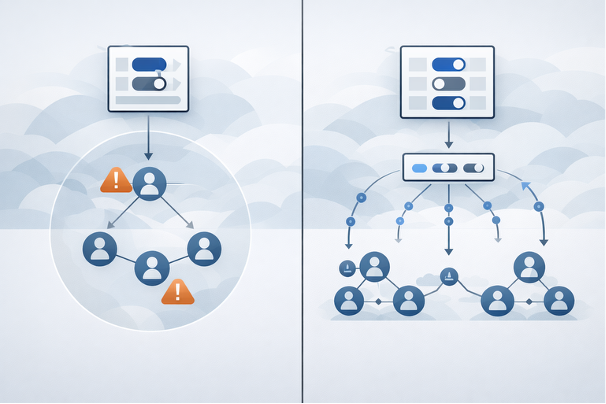
This shift enables capabilities that matter directly to the business:
- Progressive delivery instead of big-bang releases
- Instant rollback without redeploying
- Controlled experimentation with real users
- Reduced release risk and fewer production incidents
For engineering teams, feature flags enable:
- Trunk-based development at scale
- Smaller, safer pull requests
- Parallel work without long-lived branches
- Faster feedback loops
For decision-makers, they enable:
- Faster time-to-value
- Lower cost of failure
- Better alignment between product, engineering, and operations
Why Feature Flags Matter More in Cloud-Native & Microservices Architectures
Microservices increase organizational velocity – but they also increase systemic risk.
In distributed systems:
- A single change can cascade across services
- Rolling back deployments is slow and often incomplete
- Coordination across teams becomes expensive
Feature flags provide runtime control across this complexity:
| Challenge | Flags |
|---|---|
| Independent service deployment | Safe rollout of behavior changes |
| Partial failures | Fast mitigation without redeploy |
| Multi-tenant systems | Customer-specific enablement |
| Continuous delivery | Release on your terms, not your pipeline’s |
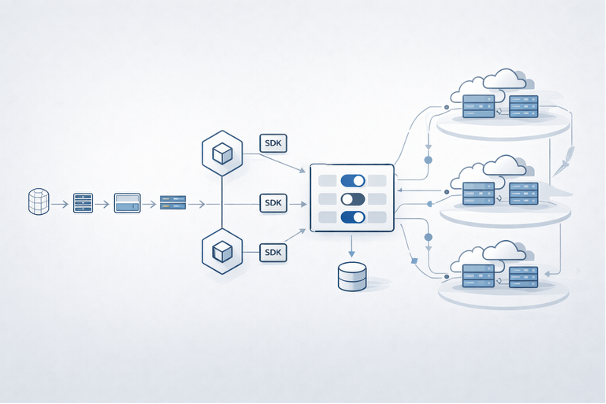
When applied consistently, feature flags become an architectural control plane for behavior – not just a development convenience.
Why Open-Source Unleash?
We base our solution playbook on Unleash because it provides a strong balance of openness, enterprise readiness, and architectural flexibility. Unlike proprietary platforms that introduce tight vendor coupling, Unleash operates with transparent open governance, giving organizations full control over how and where the system runs. Its robust role‑based access control, detailed auditing, and flexible rollout strategies—ranging from user‑based and environment‑based rules to percentage rollouts and custom conditions—fit naturally into modern cloud‑native environments.
From an architectural perspective, Unleash integrates cleanly with existing platform components. Teams maintain ownership of their infrastructure, security boundaries remain clear, and feature management becomes a native capability rather than an external dependency. Because Unleash provides first‑class SDKs across contemporary languages and frameworks, teams can adopt it incrementally without disrupting existing delivery pipelines. This combination of openness, enterprise‑grade features, and platform alignment makes it a particularly strong fit for organizations seeking sustainable, long‑term feature flag adoption
Feature Flags Are Practice, Not Just a Tool
Many organizations underestimate that feature flags introduce not only new capabilities but also new responsibilities. Without clear discipline, the very mechanism designed to reduce risk can unintentionally create it. Flags that were meant to be temporary sometimes remain in the codebase indefinitely, gradually increasing complexity. Development teams may lose track of ownership, and without documented processes, operational changes can occur without proper visibility.
This is why feature flags must be treated as a delivery practice—not merely a technical implementation. Governance, lifecycle management, naming conventions, cleanup routines, and testing strategies all play essential roles. To support this, we created a structured Feature Flag Solution Playbook that ensures teams can scale the practice safely and sustainably across multiple services and teams. The goal is simple: achieve the benefits without accumulating hidden operational debt.
Introducing feature flags without discipline leads to:
- Permanent flags that never get removed
- Hidden complexity in code
- Unclear ownership and governance
- Increased cognitive load instead of reduced risk
That’s why we developed a Feature Flag Solution Playbook, not just a technical setup.
Our Feature Flag Implementation Playbook
Our playbook is the result of real-world implementation across:
- Greenfield cloud-native platforms
- Legacy system modernization
- Regulated and high-availability environments
1. Architectural Design
We define:
- Flag ownership boundaries
- Flag lifecycles (temporary vs long-lived)
- Flag evaluation strategies per service
- Performance and caching models
2. Platform & Infrastructure Setup
We implement Unleash with:
- Secure, production-grade deployment
- Environment isolation (dev / staging / prod)
- CI/CD integration
- Observability and auditability
3. Development & Delivery Practices
We introduce:
- Clear flag naming and classification
- Guidelines for testing flagged code paths
- Branching and release strategy alignment
- Flag cleanup and technical debt prevention
4. Governance & Operating Model
We help teams define:
- Who can create, change, and remove flags
- Approval flows for production changes
- Metrics for flag usage and impact
- Long-term sustainability
Business Outcomes We See Consistently
When implemented with the right patterns and governance, feature flags consistently drive measurable improvements across engineering and product teams. Organizations typically see faster and more reliable release cycles because new behavior can be rolled out gradually and reversed instantly when needed. In high‑availability environments, this ability significantly reduces operational risk and shortens incident duration.
A practical example illustrates the impact:
One client operating a multi‑service payments platform reduced their rollback time from approximately 30 minutes to under 2 minutes after adopting feature flags as part of their delivery workflow. Where a rollback previously required a coordinated redeployment across services, teams could now disable the problematic behavior instantly through a logical switch—without touching the underlying infrastructure. This capability turned a high‑stress operational procedure into a routine action and directly improved service reliability.
More broadly, organizations adopting feature flags report smoother collaboration between product and engineering teams, safer experimentation with real user segments, and a meaningful reduction in release‑related incidents. Feature flags become an accelerant for both innovation and operational stability.
Organizations adopting feature flags correctly see measurable results:
- Faster releases with lower failure rates
- Instant rollback during incidents
- Safe experimentation in production
- Reduced operational risk
- Improved collaboration between product and engineering

Feature flags become a force multiplier – not an additional burden.
When Should You Invest in Feature Flags?
Feature flags are especially valuable if:
- You operate multiple microservices
- You release frequently (or want to)
- You need controlled customer rollouts
- You want safer production experimentation
- You’re modernizing legacy systems
If you already deploy continuously but still release cautiously, feature flags are the missing link.
Why Work with Us?
We don’t just install Unleash.
We will help you.
- Decide where feature flags make sense (and where they don’t)
- Embed them into architecture and delivery workflows
- Avoid common anti-patterns and long-term maintenance costs
- Turn feature flags into a strategic capability, not a side project
Our goal is simple:
Enable your teams to move faster – without losing control.
Ready to Make Feature Flags a Core Capability?
If you want to:
- Introduce feature flags in a new platform
- Standardize feature flag usage across teams
- Migrate from ad-hoc toggles to a managed solution
- Or assess whether feature flags fit your architecture
We’re happy to help.
Let’s talk about making feature flags work for your business and your engineers.
Relevant posts
Angular vs Blazor: Choosing the right framework for your web application
What is Angular? Angular is a front-end web framework developed by Google, built on TypeScript. It allows developers to build...

Schema-Driven Messaging with Avro: A Practical Guide for Engineers
Message queues and event streams are foundational to modern distributed systems. They decouple producers and consumers, improve resilience, and allow...

RabbitMQ 4.1 Performance Enhancements Explained
Navigating through the ever-evolving landscape of message brokers can feel like trekking through a dense jungle, especially when new versions...
Governance Meets AI: How to Stay in Control of Copilot in the Power Platform
Imagine employees creating apps, flows, or reports simply through voice or text prompts. At first glance, this seems like a...

ESET Protect vs. Microsoft Defender for Endpoint
Recently I had a chance to work for a customer who has been using ESET PROTECT antivirus. The Customer however...

Microsoft 365 E7: The $99 “Frontier Suite”
A meaningful upgrade or just bundling? Microsoft has introduced a new licensing tier with Microsoft 365 E7, priced at $99 per user per month. At...
You need to load content from reCAPTCHA to submit the form. Please note that doing so will share data with third-party providers.
More Information